
Small Cinema Owners newsletter · October 2026
Australian cinema is having a better year. Now we need to turn that recovery into stronger local businesses. That means giving people more reasons to visit, making our programmes more visible and building connections that last beyond the next blockbuster.
We can no longer afford to sit back, place an advertisement in the local newspaper, leave most of the promotion to distributors and wait for the money to roll in. Local media can still play an important role. But our future also depends on what we do ourselves: the films we champion, the audiences we understand and the relationships we build in our communities.
A quick industry update: stronger revenue, fewer visits than 2019
Our August newsletter reported a substantial recovery, with attendance up 19.6% against 2025 through week 34. The latest comparable figures still show a strong year, although the pace of growth has eased.
| Weeks 1–41 | 2026 | Vs 2025 | Vs 2019 |
|---|---|---|---|
| Box office | $956.2m | +25.0% | −2.7% |
| Admissions | 50.65m | +17.6% | −21.1% |
| Average ticket yield | $18.88 | +6.3% | +23.2% |
The gap that matters is 13.5 million fewer cinema visits than in the same weeks of 2019. In the seven weeks since the August snapshot, attendance was 5.6% ahead of the corresponding 2025 period. We should welcome the improvement while recognising how much audience-building work remains.
Where has the film advertising gone?
Among independent exhibitors, a recurring observation is that outdoor film promotion feels thinner. Fewer posters on buses, fewer prominent displays around town and fewer everyday reminders of the films coming to our screens. That is an observation from operators, rather than a measured national trend.
A thinner release slate could mean fewer campaigns to encounter and could suppress total promotional spending. More targeted online advertising may also be reaching audiences without exhibitors ever seeing it. There is no clear public evidence that establishes an overall reduction in Australian distributors’ advertising expenditure. Equally, the public information does not give cinemas a clear account of where theatrical marketing dollars go or which local communities they reach.
The broader advertising market shows where attention is moving. IAB Australia reports that online advertising reached $19.8 billion in FY2026, with search and video the largest categories and social video growing strongly. Outdoor advertising as a whole also grew in 2025. These figures describe the wider market, not film distributors’ budgets, but they caution against assuming that less visible film promotion means advertising has simply stopped. IAB Australia; Outdoor Media Association.
For an exhibitor, the practical question is local: are people within reach of our cinema hearing about the film, and can they easily find our sessions? A national campaign can generate impressive numbers without telling us much about that.
Better communication would help both sides. Campaign dates, target audiences, regional coverage, links to local sessions and timely access to artwork and trailers would help cinemas coordinate their own promotion. Views and impressions are useful measures, but they are not the same as additional tickets sold.
Taking control of our own audience
Whatever happens to national campaigns, we need to invest more deliberately in our own marketing. This is about time and attention as well as money. A recommendation from a trusted local cinema, a well-chosen event or a partnership with a community group can give a film a reason to matter locally.
Curation is part of that work. Match a film to a book club, school, sporting group or local interest. Build a seniors’ programme people can rely on. Give families a clear picture of what is coming in the holidays. Work with hotels and visitor businesses to put a night at the movies in front of people who might otherwise never think of it.
Then make the invitation consistent: in the foyer, on social media, through the cinema’s mailing list and in partner locations. People need to know both why a film is worth seeing and when they can see it with us.
If exhibitors are taking on more of the work and cost of creating demand, should film-hire policy change to support that effort? Could lower hire terms, more flexible minimum guarantees, marketing allowances or matched local promotional support give cinemas room to invest? These are questions worth discussing with distributors. Both sides benefit when local promotion brings in additional audiences.
SCO is putting practical tools behind the words
SCO is bringing Cinema-Sign to the industry to help cinemas make better use of posters, trailers and session information. The player software is free, with no per-screen subscription. It is a practical way to improve promotion while reducing some of the repetitive work and costs around it.
Designed for worldwide use, Cinema-Sign already supports classification badges for 16 countries and regions—and counting: Australia, Canada, France, Germany, Hong Kong, Iceland, India, Japan, the Netherlands, New Zealand, Norway, Singapore, South Korea, Spain, the United Kingdom and the United States. Cinemas can select the regional classification artwork and use 12-hour or 24-hour session times to suit their audience. See the current feature list for the latest coverage.
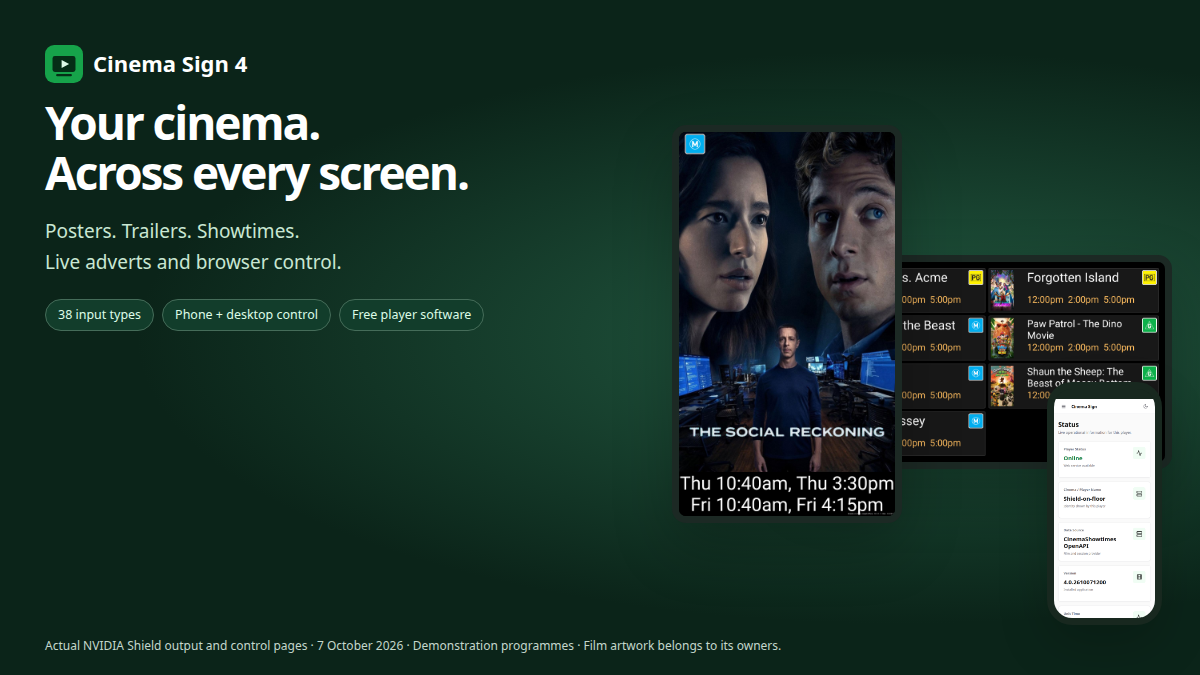
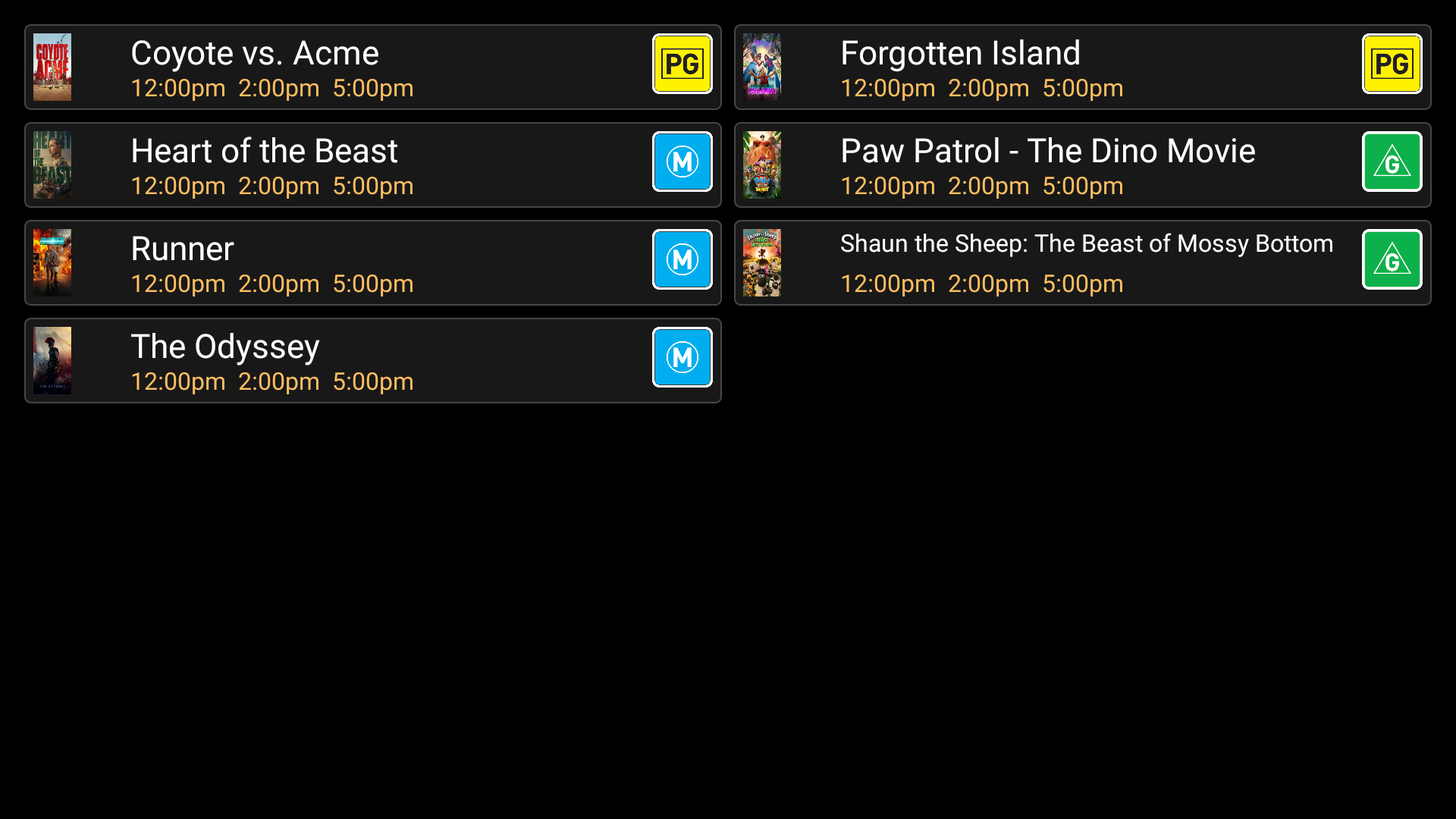
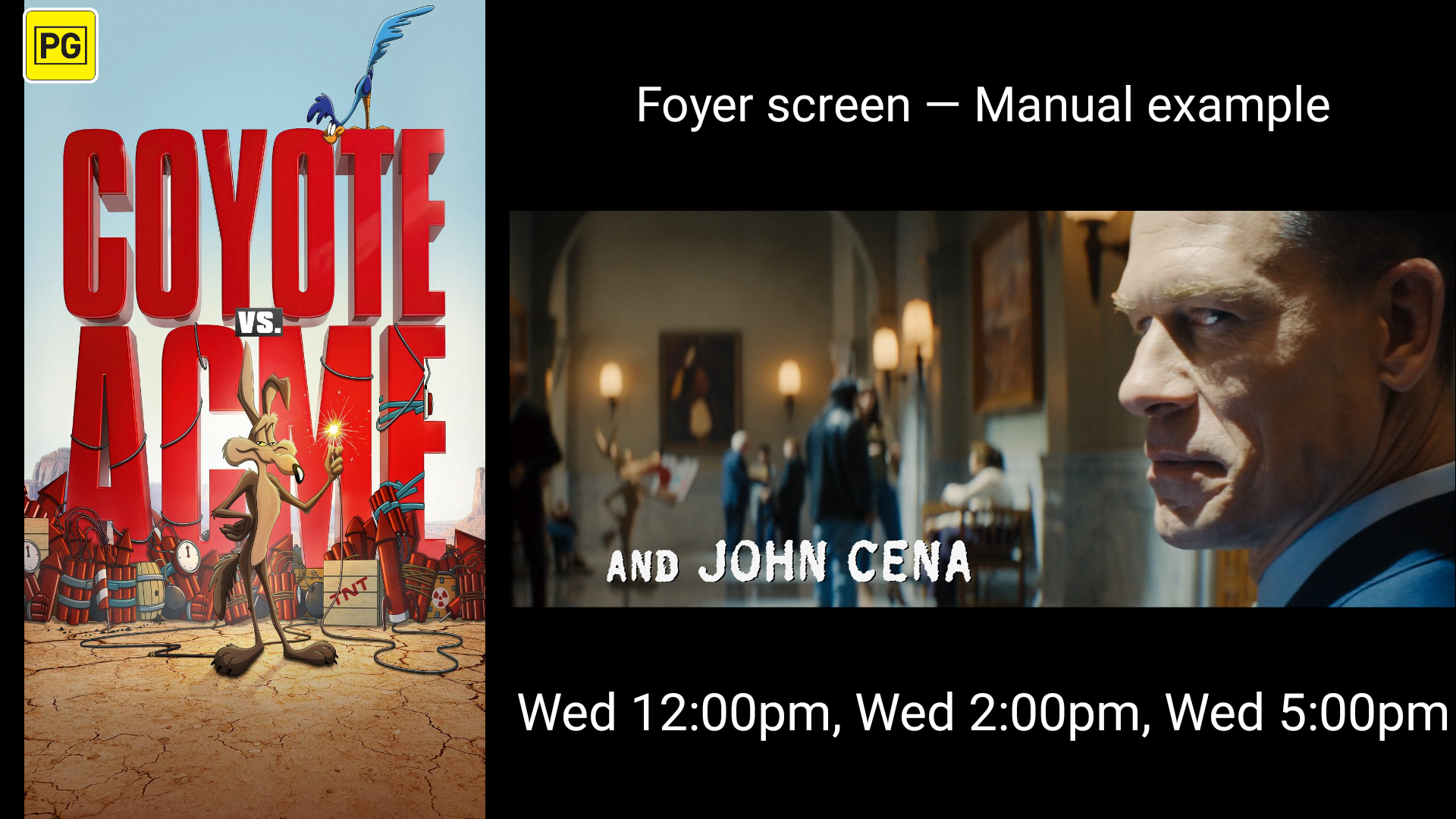
A screen can promote the current programme, rotate Coming Soon posters, show trailers or provide a clear session-time board. Supported POS programme feeds can keep displays up to date automatically. Staff can also manage the player from a phone or computer on a reachable network. Different screens can serve different purposes.
For exhibitors, that can mean less time changing posters and updating session displays. For distributors, replacing some printed material with digital artwork can reduce printing, packing and freight. These are potential savings, rather than a promise that every installation will pay for itself in a particular period.
Paper posters will retain an important role, particularly outdoors and wherever a powered display is impractical. Digital signage gives us another way to use limited space and keep more films visible.
Watch: Cinema-Sign in action — Watch on YouTube.
Two practical display examples

Take the programme beyond the cinema doors
Imagine a display at the local newsagency, a hotel reception or a community partner’s venue, showing what is on at your cinema. With suitable programme access and connectivity, it can update without someone making a trip each week to replace a poster.
That brings local relationships and practical technology together. A hotel can help visitors find an evening activity. A newsagency can put coming attractions in front of regular customers. A community partner can help promote a screening relevant to its members.
Screens are now available for a few hundred dollars, making a small trial more approachable. Hardware, mounting, power, connectivity and any paid feed or media access still need to be considered. Test the actual screen and player before expanding, especially for portrait use or long operating hours. Off-site displays also need a suitable connection; local browser control is not automatically an internet-wide management service.
The shift to digital projection showed how changing the way content is delivered and handled can create new opportunities. Digital signage is a smaller investment with different economics, but the same practical ambition: reduce repetitive handling, improve flexibility and make resources go further for distributors and exhibitors.
Start with one useful display and one clear purpose. Explore the Cinema-Sign overview, features and setup guide.
What should SCO work on next?
Cinema-Sign is part of a wider effort to give cinemas useful, affordable tools. We want feedback on where that effort will make the biggest difference. These are development priorities for discussion, not a promise that every tool is already available.
1. Social media promotional tools. Would tools that turn your weekly programme into editable Facebook and Instagram posts, images and short videos save you time? The aim would be to make local promotion easier while keeping the cinema in control of what gets published.
2. AI-assisted sales and audience analysis. Would clearer explanations of session performance, booking patterns and changes in customer behaviour help you make decisions? Useful analysis should work from your own data, show its assumptions and respect customer privacy.
3. Free theatre-management tools. CatcherTMS is being developed to simplify cinema operations. Its current development build brings together content ingest, checking, transfers and related operational tools. Broader TMS functions remain in active development. We want to hear which routine jobs most need improvement.
4. Community partnership and group-booking tools. Could simpler ways to organise fundraisers, school visits, club screenings and hotel partnerships help turn local connections into regular attendance?
5. Marketing results you can understand. Would distinct booking links, QR codes and offer codes help you see which promotions bring customers to your cinema? Connecting promotional activity with bookings would make it easier to decide where the next dollar should go.
6. Printable session-time promotions in CatcherTMS. Would it help to generate a branded weekly programme directly from your session data, ready to print for the foyer, local shops, hotels and community noticeboards? We are considering bringing this into CatcherTMS, with a choice of dates, film and poster counts, and print layouts. The aim would be to keep paper promotion useful while saving the time spent retyping sessions and laying out a new sheet each week.
7. A simpler preshow advertising system. Smaller regional cinemas outside the coverage of larger cinema advertising networks should have practical tools to build their own local advertising business. Could a system that assigns advertising contracts to registered screens, records campaign dates and agreed screenings, and manages the preshow programme make that work easier?
The proposal would include converting supplied MP4 advertisements into cinema-ready DCPs, checking picture and sound, and applying consistent CPL names and campaign identifiers so each version can be recognised and tracked. Scheduling would start and stop advertisements on the agreed dates, with playback records from supported cinema systems to distinguish ads actually played from ads merely scheduled. Clear reports and alerts for missed plays or expired campaigns would help cinemas deliver what they have sold and give local advertisers confidence. Would this help you grow local revenue with less administration?
Tell SCO your top two priorities, and describe one recurring task or problem you would most like solved. Email/Reply to this to share your feedback.
A stronger release slate helps. Stronger local relationships help too. Our opportunity is to use both: champion the films, connect with our communities and equip ourselves to turn interest into visits. SCO is putting tools behind that effort, and your experience should help shape what comes next.
Add your name to SCO
Forging our own future also means standing together. The Industry Support / Members list on our About SCO page recognises the people and cinemas who support that effort. Thank you to everyone already listed. Your support helps show that smaller cinemas have a shared interest in practical innovation, stronger local businesses and a stronger voice in our industry.
If you value the work SCO is doing, from sharing industry information to bringing tools such as Cinema-Sign to market, please consider adding your name. SCO is a free association for qualifying small cinema operators, built around sharing knowledge, resources and goodwill.
Visit the About SCO page to see who is involved, then contact SCO to request that your name be added. Include your name, cinema and town or region, and confirm that you would like those details listed publicly. Together, we can turn shared ideas into practical benefits for our cinemas and the communities we serve.
