
What the recovery means for Australia's small independent cinemas.
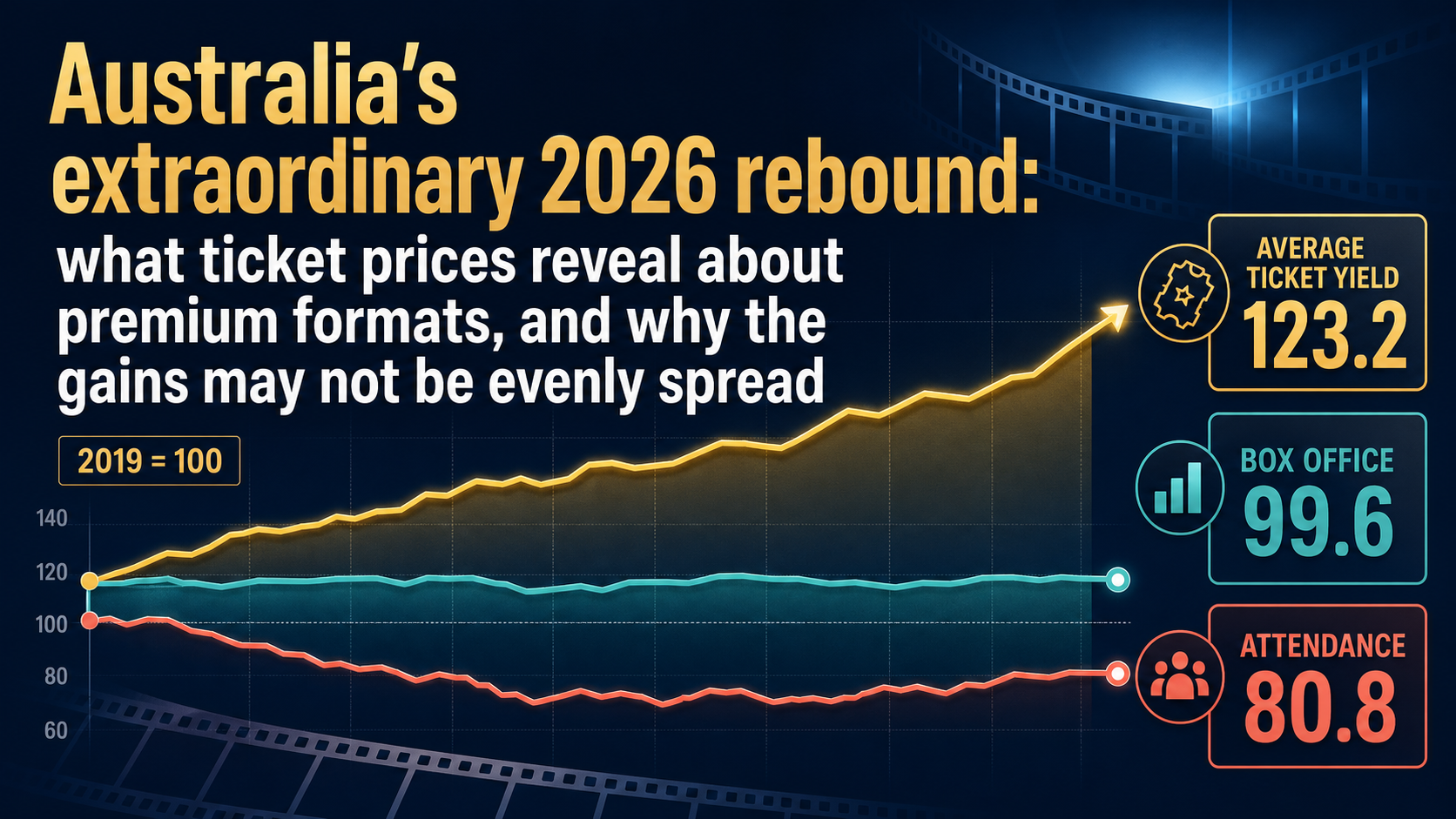
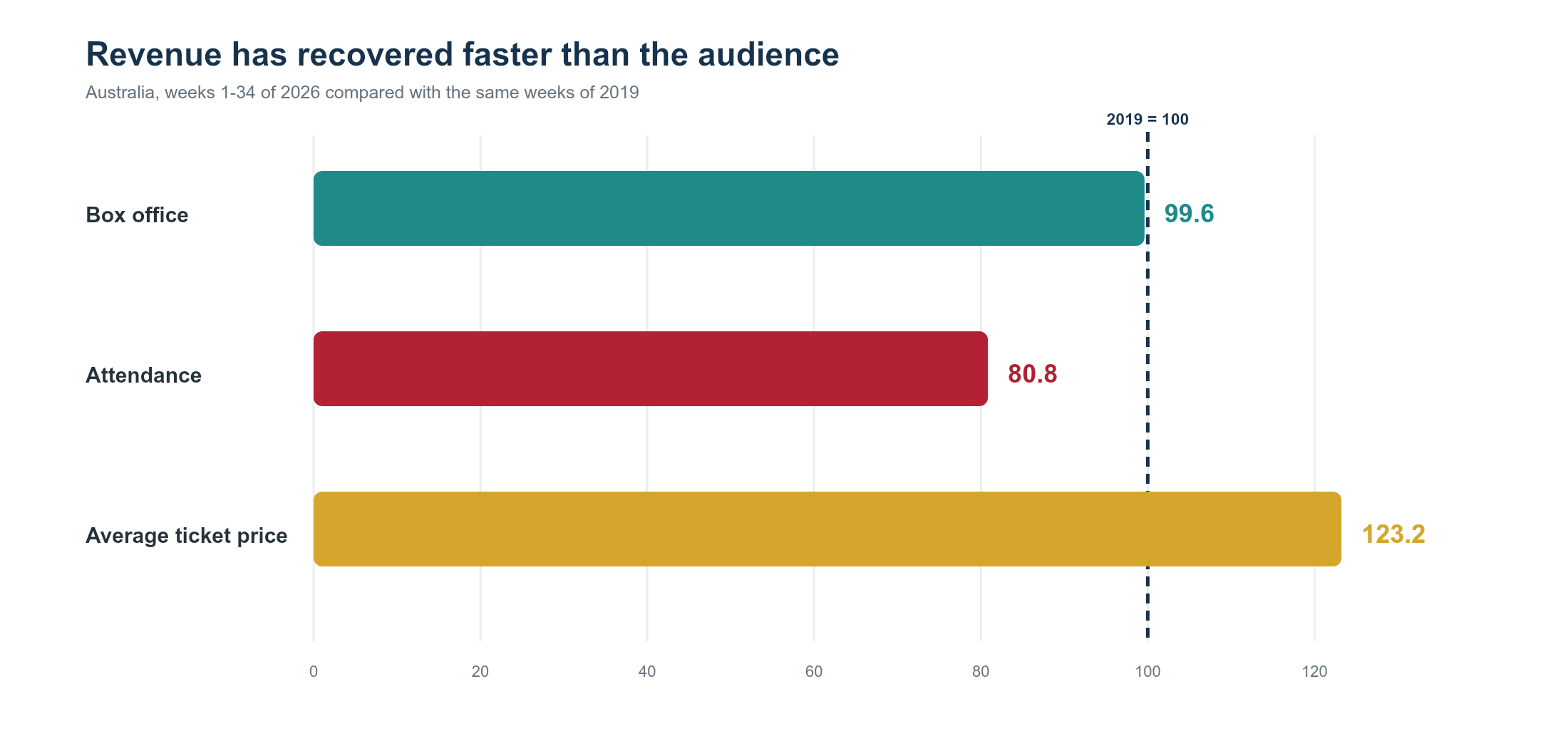
The headline: By week 34, Australian box office had almost regained its 2019 level – with 10.5 million fewer cinema visits.
There is no need to talk down what has happened in 2026. After several years of false starts, Australian cinema has delivered the first truly convincing recovery of the post-pandemic period. Attendance is up sharply, the release slate is connecting, and the national box office has returned to the doorstep of 2019.
For operators who have spent years deferring maintenance, working longer hours and wondering whether the next quarter would finally turn, that is genuinely wonderful news. The demand for cinema did not disappear. Audiences will still come out in force when the film and the experience feel worth leaving home for.
But the way the recovery is arriving matters. Revenue has recovered much faster than visits. A growing share of the value appears to be concentrated in event films, premium presentations and higher-priced tickets. For large operators with a broad PLF footprint, that can be a powerful earnings engine. For small independents, it may mean that the national headline is running ahead of the recovery visible at the local box office.
First, the good news: 2026 is a real recovery
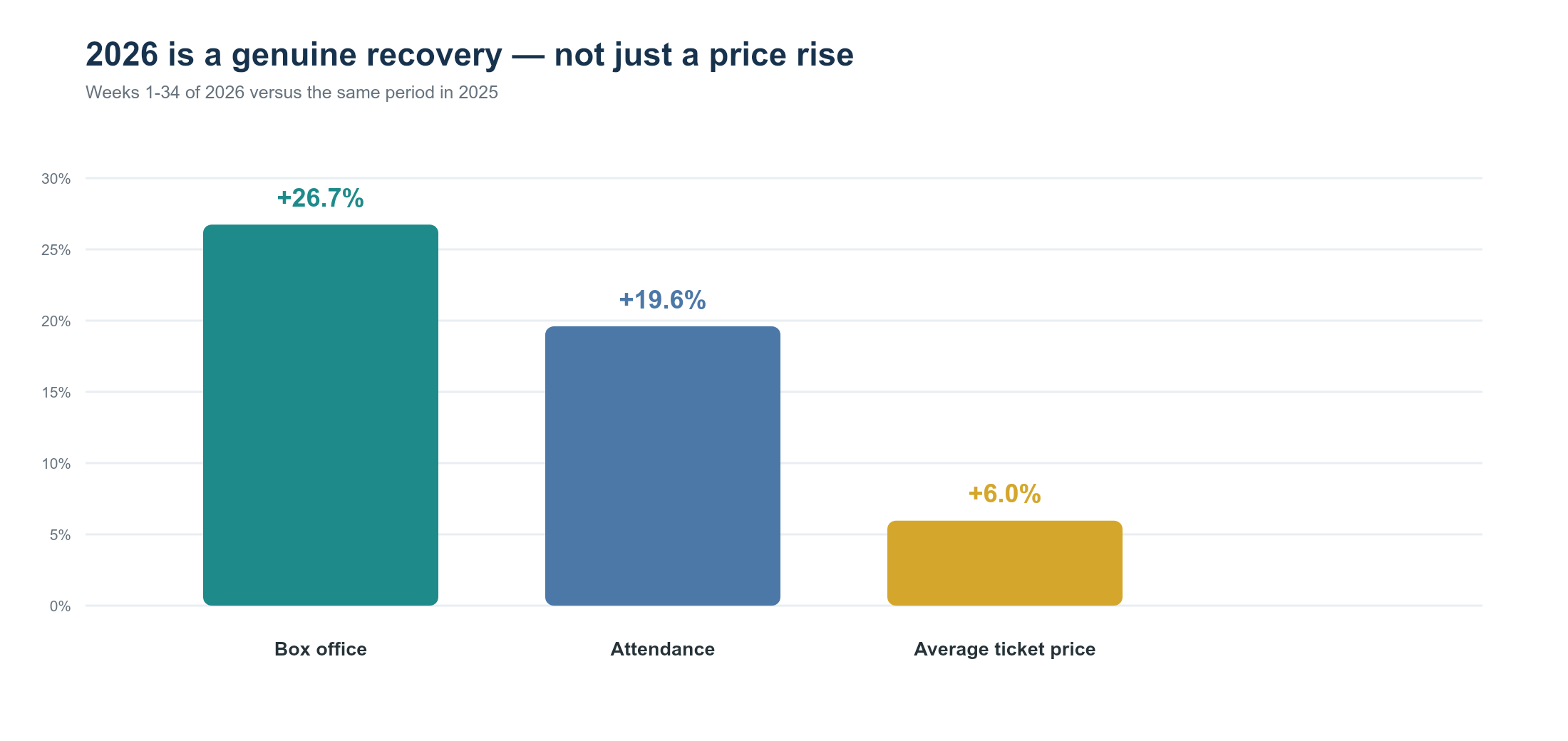
Through the week ending 20 August, national box office was 26.7% ahead of 2025 and attendance was 19.6% ahead. That is not a recovery created only by a higher ticket price. Most of the improvement is more people returning to cinemas.
This is also broader than the 18-week snapshot published by SCO in May. At that point, attendance was 12.5% ahead of 2025. By week 34, the comparable increase had strengthened to 19.6%. Momentum has survived multiple release cycles and the mid-year holidays.
The positive case deserves to be stated clearly:
- Audiences are responding to a stronger, more consistent slate.
- Cinema remains one of the most accessible shared out-of-home experiences.
- The appetite for spectacular, communal and culturally relevant films is emphatically alive.
- A stronger cash-flow year gives operators a chance to move from survival toward maintenance and selective reinvestment.
The central finding: box office is back; frequency is not
| Period | Box office | Attendance | Average ticket yield |
|---|---|---|---|
| 2019, weeks 1–34 | $836.3m | 54.6m | $15.32 |
| 2025, weeks 1–34 | $657.3m | 36.9m | $17.82 |
| 2026, weeks 1–34 | $833.0m | 44.1m | $18.88 |
Table 1. Comparable year-to-date totals. Average ticket yield is box office divided by attendance, so it includes format, location, film, age and discount mix.
In the first 34 weeks of 2019, Australians made 54.6 million cinema visits. In the same period of 2026, they made 44.1 million – 10.5 million fewer. Yet box office is only $3.2 million lower. The average amount of box office collected per admission has risen from $15.32 to $18.88.
That is the new recovery equation: fewer visits, worth more each. It is a viable commercial model for parts of the industry, but it is not the same as restoring the habit of cinema-going across the population.
A better view of ticket prices – and the tentpole effect
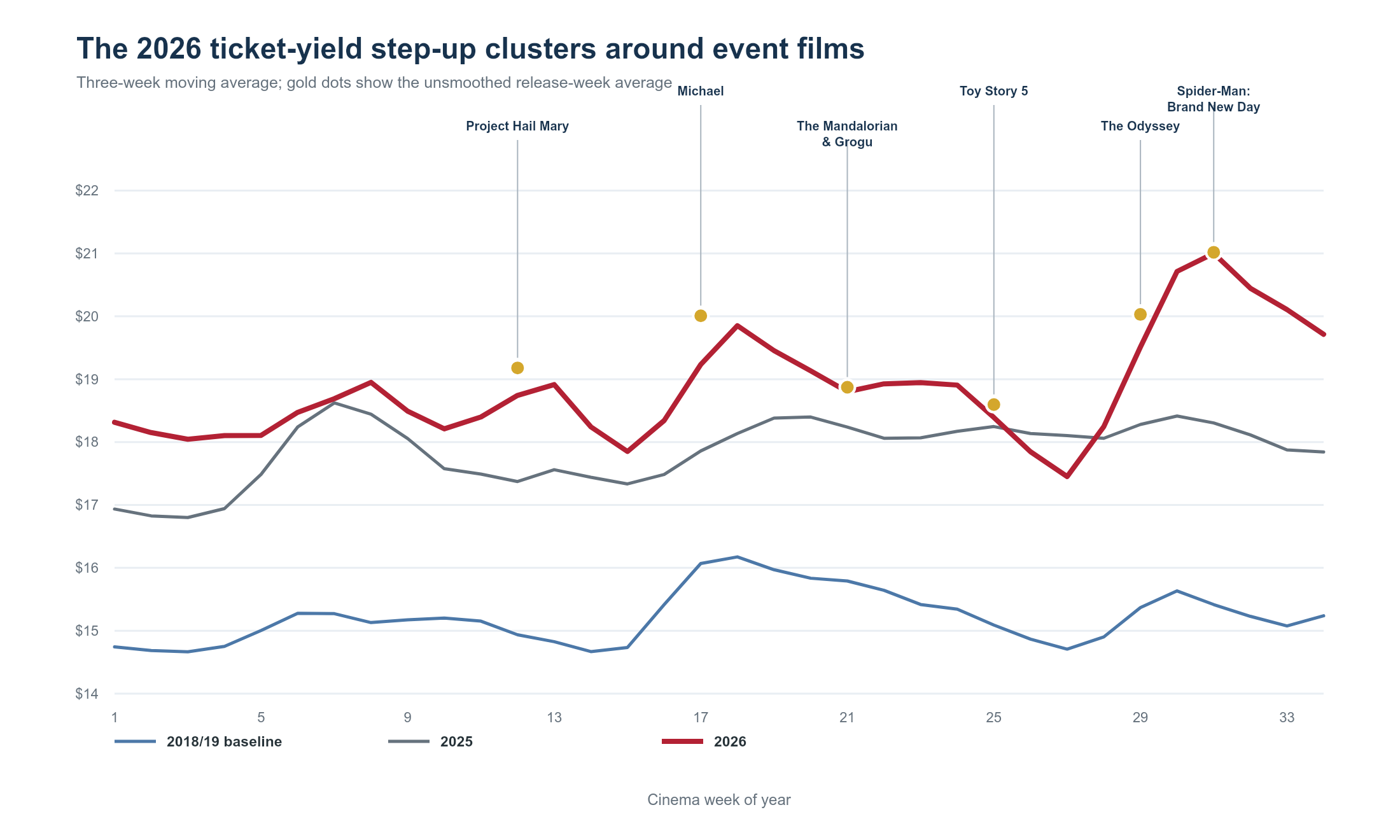
The chart shows a clear structural step-up in 2026. The pre-pandemic baseline generally sits near $15–$16. The 2025 line is mostly around $17–$18.50. In 2026, several event-film periods move close to or above $20, with a particularly strong run around The Odyssey and Spider-Man: Brand New Day. The raw weekly average reached $21.09 in week 30 and $21.02 in week 31.
It also shows why we should avoid a simplistic claim that every blockbuster raises the ticket average. Family-heavy weeks can produce excellent attendance with a lower yield because of child pricing, family offers and session mix. The price signal is strongest where an adult-skewing event film aligns with premium-format demand.
The inflation test: an important qualification
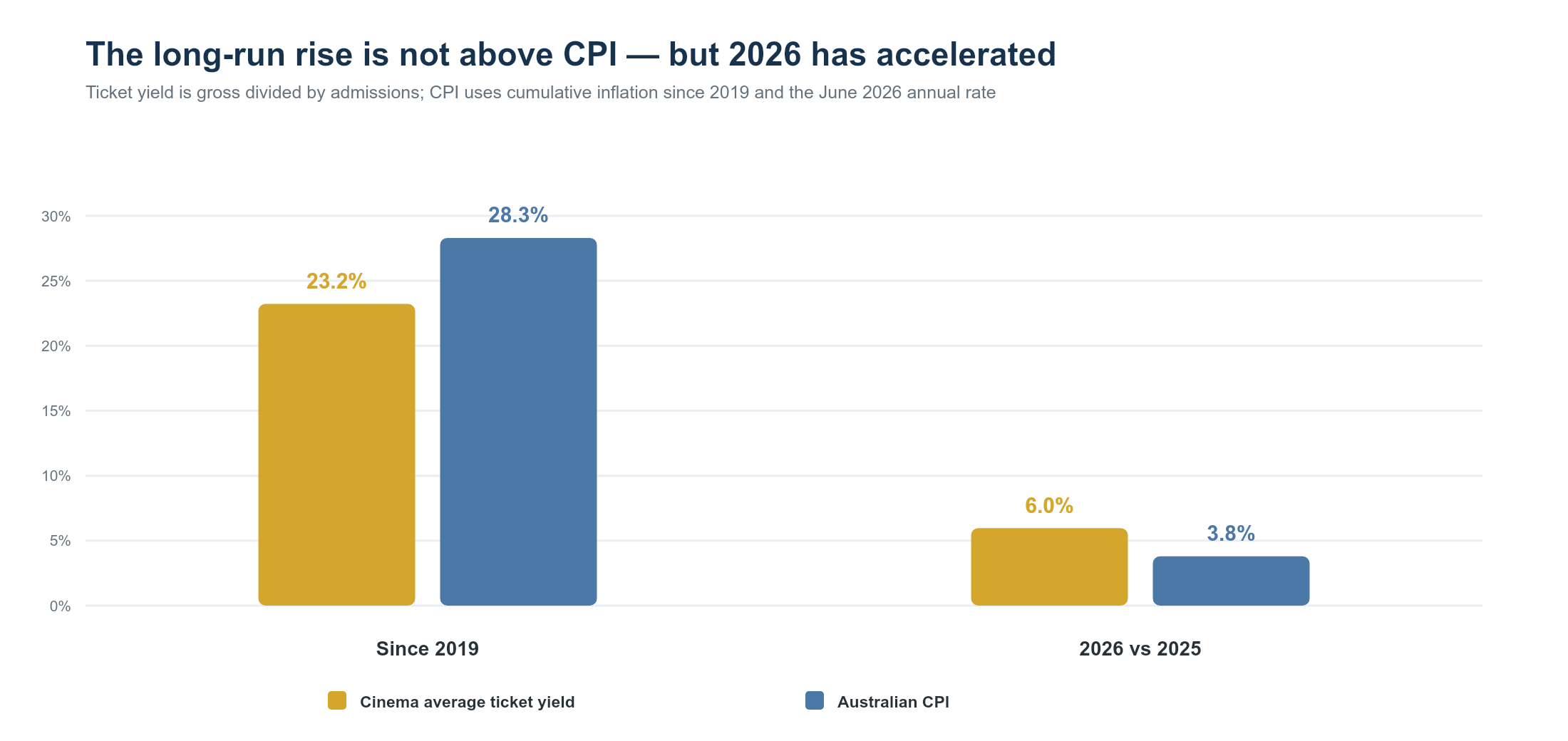
The long-run comparison is more nuanced than the weekly peaks suggest. Comparable average ticket yield is 23.2% above 2019, while cumulative general inflation was 28.3%. Across the whole period, cinema ticket yield has not outrun the general price level.
What has changed is the current pace and the composition. Ticket yield in the first 34 weeks of 2026 is 6.0% above the comparable 2025 period, while annual CPI was 3.8% in June. The acceleration is concentrated around certain titles and weeks. That pattern is consistent with premium-format and audience-mix effects, not merely a uniform rise in the standard ticket price.
Interpretation: The Australian data shows a clear price-and-mix bridge between attendance and box office. It does not, by itself, quantify how much of that bridge is PLF.
Is PLF doing the heavy lifting? The global evidence says it matters
The available Australian figures do not separate attendance by format, so we cannot say exactly how much of the difference comes from PLF. However, public operator results show the same pattern internationally: attendance can be flat or down while average ticket price and admission revenue rise, with operators explicitly crediting PLF mix.
| Evidence | What it shows | Why it matters for SCO |
|---|---|---|
| AMC, 2025 | Attendance −2.1%; average ticket price +5.9%; admissions revenue +3.6%. AMC cited more attendance in 3D, IMAX and other PLF screens. | A large operator can grow admission revenue while serving fewer visits. |
| Marcus, FY2025 | Average ticket price +3.7%, helped by a higher share of ticket sales from PLF screens and pricing programs. | The mix shift is explicitly identified, not inferred. |
| Cinemark XD, 2024 | About 13% of global box office from roughly 5% of screens – around 2.6 times the average box-office share per screen. | Premium rooms can take a disproportionate share of revenue. |
| IMAX, 2025 | $1.28bn global box office: +40% year on year and 13% above its 2019 record; 3.8% of global box office from just over 1,800 locations. | The premium segment has already exceeded its pre-pandemic revenue peak. |
| Europe, 2025 | Final UNIC data: box office down about 1.2% while admissions fell 4.4% to 873.2m. | The revenue/attendance divergence is not uniquely Australian. |
The conclusion is not that PLF alone created the Australian recovery. The 19.6% attendance uplift proves that content and audience demand are doing most of the work versus 2025. The stronger conclusion is that premium formats are amplifying the revenue value of the recovery and may be concentrating that value in locations able to sell a branded premium experience.
Why the recovery may feel smaller at a small cinema
1. PLF can redistribute revenue, not only create it
A customer who chooses an IMAX, Vmax, Titan Luxe or another premium session may still have gone to the cinema without that option. Some premium demand is incremental; some is a transfer from a standard auditorium or a competing site. If the national average rises because more patrons are routed into premium rooms, a standard-format independent can underperform the national box-office headline even while holding its local attendance.
2. Marketing can make standard cinema feel like the lesser product
The industry's language increasingly tells audiences that the “real” way to see a tentpole is in a named premium format. That can lift urgency and willingness to pay, which is good for cinema as a medium. But it can also unintentionally devalue a well-run standard auditorium, even when its picture, sound and hospitality are excellent.
3. Cinema risks becoming an opera night out
Eventisation is powerful, but there is a long-term frequency risk if the public begins to treat cinema as a rare, expensive occasion rather than a regular habit. The full family outing – tickets, food, travel and parking – matters more than the headline ticket. A market can support spectacular $25–$40 premium occasions and still lose the casual visit that sustains the films between tentpoles.
4. The capex answer may be wrong for the catchment
The premium segment is attractive precisely because it is scarce and differentiated. Copying a major-chain PLF strategy in a small catchment can create high fixed costs, utilisation risk and a need to raise prices before demand is proven. The earlier SCO warning about premium saturation remains valid: today's over-index can compress as more premium seats chase the same event audience.
The opportunity: Small cinemas do not need to win a technology arms race. They can win the regular visit: accessible pricing, trustworthy presentation, local relevance and a welcome that a branded format cannot manufacture.
The economic weather: strong cinema demand in a weak consumer setting
The recovery is occurring against difficult household conditions, which makes it more impressive – and more fragile. The ABS reported annual CPI inflation of 3.8% in June 2026. The Reserve Bank's August outlook expects subdued GDP growth through 2026 as high inflation, tighter monetary policy and weaker established housing conditions weigh on demand.
The RBA's base case is not a declared recession. It expects growth to slow and then recover gradually. But it also says housing prices have declined noticeably, assumes they continue to decline gradually for a period, and identifies a larger housing downturn or weaker activity as downside risks. Lower housing wealth can reduce household consumption, while unemployment is forecast to rise gradually.
For cinemas, the practical point is simpler than the macroeconomic label. Discretionary spending will remain selective. Customers will choose fewer outings, compare the total cost more closely, and demand a clear reason to attend. Regional locations can face the additional burden of fuel, distance and a smaller pool of high-frequency patrons.
Cinema still has a resilience advantage. It is cheaper than a concert, major sporting event or short holiday; it is local; and it delivers social escape when households need it. A 2026 Global Cinema Federation survey found 70% of respondents were excited to see a film in cinemas during the year. The demand is there. The job is to keep entry to that demand broad.
What the recovery really means for small independents
Start with the good news: 2026 proves that cinema still matters. Put the right film on screen and people will leave home, gather with others and pay for an experience they cannot reproduce in the lounge room.
But two recoveries are happening at once. Large operators with PLF screens can turn an event film into a much higher-value visit. Most small independent cinemas cannot offer branded PLF. Their recovery still depends mainly on how many people walk through the door, how often they return and whether an ordinary week can cover the bills.
The practical reality: The national recovery can be real while trading conditions for a small independent remain marginal. Higher industry box office does not automatically mean a secure local business.
1. A strong slate is welcome – but it is not a dependable profit centre
This year's major films have connected unusually well. That has produced powerful peaks, but the visits are still centred on events rather than a restored weekly habit. A cinema can be full for a tentpole and quiet again soon afterwards.
That makes the business harder to run. Event demand creates sharper swings in staffing, stock, scheduling and cash flow. A handful of exceptional weeks may carry months of softer trading, and one delayed or disappointing title can leave a large hole. Volatility is itself a cost.
We should therefore treat 2026 as valuable breathing room, not proof that admissions have returned to a reliable pre-pandemic pattern. Content this strong is an opportunity. It should not be the only assumption holding up a budget or an investment case.
2. Independents can offer a different kind of premium
A small cinema may not be able to build an IMAX or another branded large format. It can still make cinema feel special. The independent advantage is not the size of the screen alone; it is the care around the whole group experience.
- Make presentation quality obvious: bright images, well-balanced sound, clean lenses, correct masking and a comfortable room.
- Bring back showmanship: welcome the audience, introduce selected sessions and make opening night feel like an occasion.
- Design for groups: easy bookings, family and friendship bundles, social spaces and simple food-and-drink packages.
- Program with local knowledge: community events, classics, festivals, schools, seniors, filmmaker visits and films that matter to the catchment.
- Keep the value clear: customers should be able to choose a good, affordable standard visit without being told it is the inferior product.
This is not second-best PLF. It is a different promise: a well-run, welcoming place where people can share a film with their community.
Protect cash before chasing the headline
The economic setting still contains major unknowns. Household budgets are tight, housing values are falling and the outlook for spending and employment is uncertain. In that environment, a large fixed investment can turn a slow month into a serious problem.
Small operators should keep doing the maintenance that protects safety, reliability and the customer experience. Beyond that minimum, significant spending deserves a high hurdle. Test every proposal against conservative attendance, long quiet periods, higher finance costs and the possibility that the next slate will not perform like 2026.
A simple investment test: If an investment only works when every year looks like 2026, it does not yet work. Use the rebound to strengthen the business before adding costs the next downturn cannot carry.
The old cinema habit is not simply coming back
It is tempting to assume that a few strong years will take cinema back to the way it was. That is unlikely. The world has changed: audiences have more entertainment at home, household costs are higher, and cinema visits are increasingly triggered by a specific film or social occasion.
That does not mean decline is inevitable. It means the regular visit has to be rebuilt rather than awaited. Each event film should be used to collect contacts, promote the next reason to return and remind customers that cinema is more than the handful of titles marketed as essential premium viewing.
The industry also needs to acknowledge the uneven recovery. It should measure admissions as seriously as box office, report PLF and standard-format performance more clearly, protect the value of a good standard presentation and recognise that smaller sites may still be operating on the margin even when national revenue looks healthy.
The recovery is real. So is the risk.
Australian cinema has achieved something remarkable in 2026. Box office has almost caught 2019 and attendance has risen sharply in a single year. PLF is helping turn the biggest films into valuable occasions, and that is good news for the medium as a whole.
For independents, however, PLF is not a practical blueprint. The stronger path is disciplined operation, excellent presentation, visible showmanship and a group experience rooted in the local community. Those things can make an ordinary cinema visit feel worth choosing without loading the business with unsustainable capital costs.
This is a moment for confidence, but not complacency. Celebrate the rebound. Bank the stronger weeks. Repair what customers can see and feel. Be cautious with everything else. The next stage of recovery is not merely to earn more from each event visit; it is to make cinema-going broader, more regular and more dependable again.
The next recovery target: Turn exceptional event attendance into a broader cinema habit – without asking small operators to finance a recovery they have not yet fully received.
James Gardiner
Principal, Small Cinema Owners (SCO)
Sources and methodology
The Australian charts use SCO analysis of weekly Comscore box office and attendance data through cinema week 34, beginning 20 August 2026. Average ticket yield means box office divided by attendance. It is not a posted standard ticket price and will move with format, location, age, film, discount and session mix.
Comparable-period totals are used throughout: weeks 1–34 are compared with weeks 1–34. The 2018/19 line in Figure 3 is the mean of each year's weekly ticket yield, smoothed with a centred three-week moving average. Pandemic-distorted 2020 data is intentionally excluded.
The long-run comparison uses cumulative general inflation of 28.3% between 2019 and 2026. The current annual comparison uses the ABS June 2026 CPI rate of 3.8%. These are context measures and should not be read as a formal real-price index.
- SCO: The recovery nobody expected – Australian cinema attendance is up over 12%
- SCO: Is PLF the magic bullet for cinema exhibition?
- AMC Entertainment 2025 Form 10-K
- The Marcus Corporation 2025 Form 10-K
- Cinemark 2025 proxy
- IMAX: record $1.28 billion global box office in 2025
- UNIC Annual Report 2026
- Global Cinema Federation 2026 moviegoer survey
- Screen Australia: cinema audience attendance patterns
- Australian Bureau of Statistics: CPI, June 2026
- Reserve Bank of Australia: August 2026 outlook
- Reserve Bank of Australia: August 2026 overview
- ABC News / Cotality: national property values fell 0.7% in July 2026
