
A Good Year, But Not A Simple One
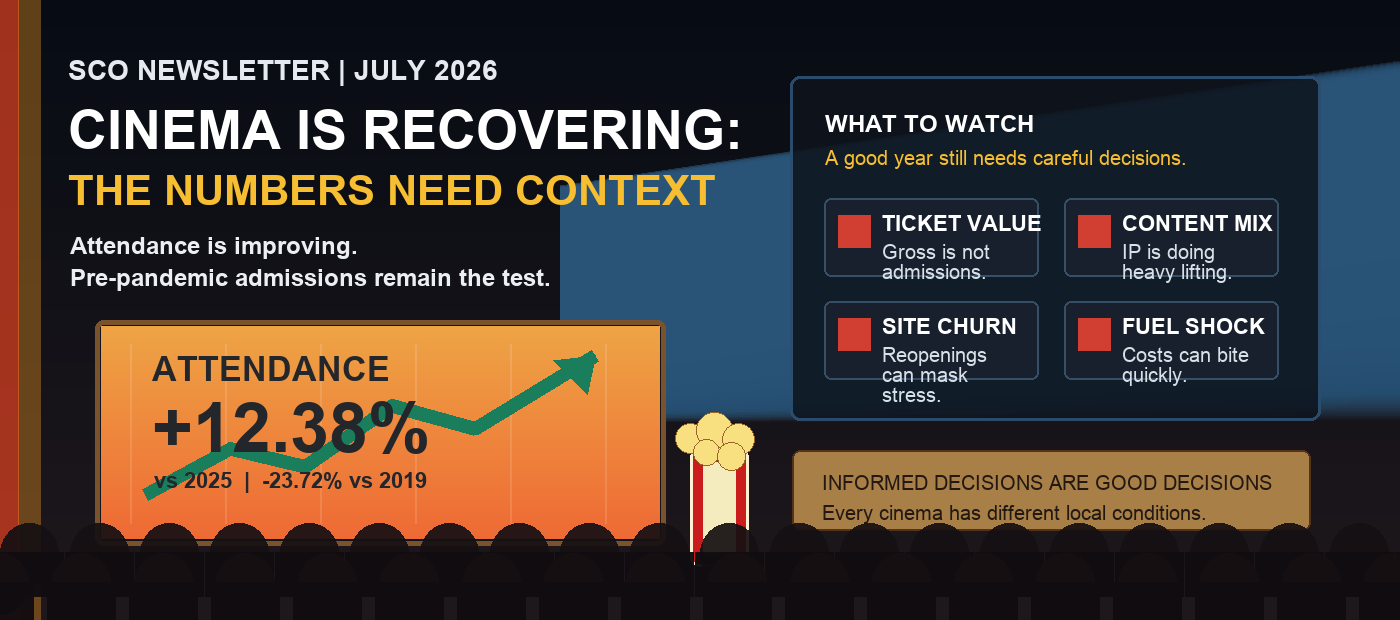
The cinema year has improved. That should be said plainly. SCO analysis through the week commencing 16 July 2026 shows Australian cinema attendance running 12.38% ahead of the same weeks in 2025. Box office is stronger again, up 17.22% on the same comparison. After several years of disrupted supply, strikes, cost pressure and uneven audience behaviour, that is a welcome result. The purpose of this newsletter is not to turn that result into a victory lap. It is to help operators and industry partners make better decisions. An informed decision is a good decision, and every cinema sits in different local conditions: different rents, demographics, programming options, transport patterns, staffing costs, competitive pressures and community relationships. The deeper signal is mixed. Attendance is still 23.72% below the same weeks of 2019, while box office is only 7.40% below 2019. Revenue has moved closer to pre-pandemic levels faster than the audience has, largely because average ticket value has lifted. That does not make the recovery false. It does mean we need to read the recovery carefully.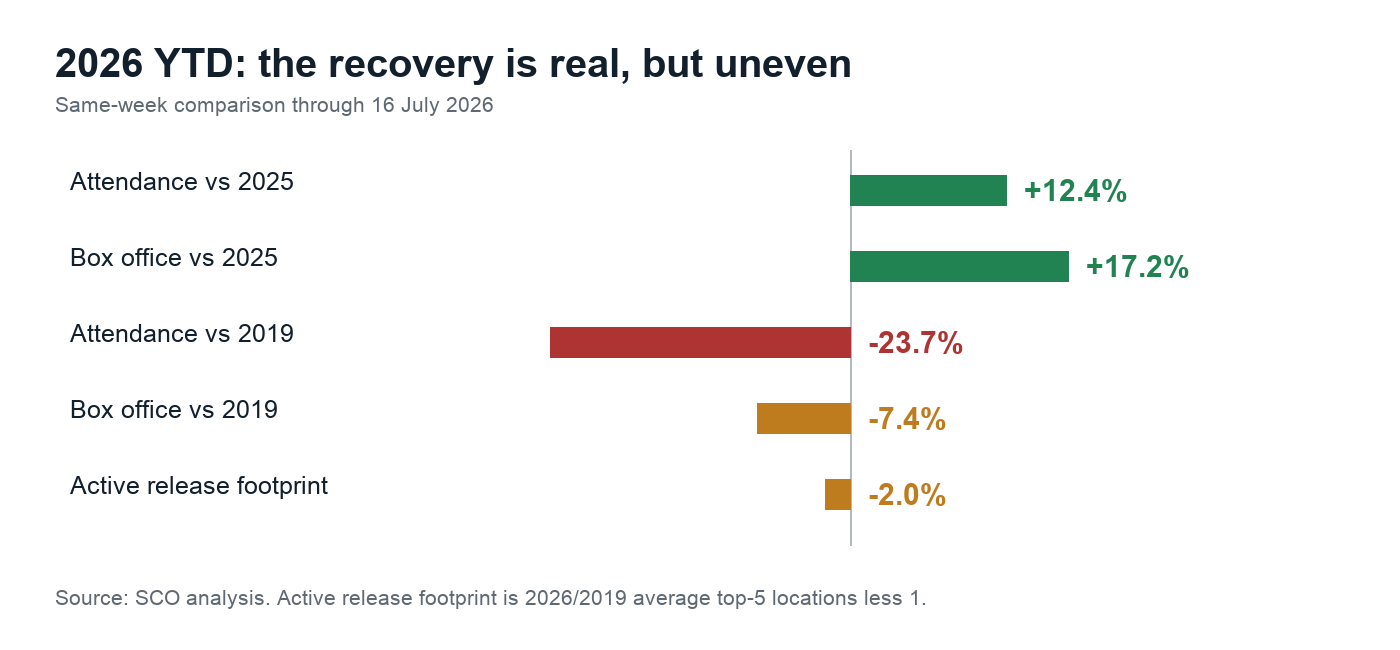
What The SCO Analysis Is Saying
| Measure | Current reading | Vs 2025 | Vs 2019 |
|---|---|---|---|
| YTD attendance | 36,825,829 | +12.38% | -23.72% |
| YTD box office | $682,752,263 | +17.22% | -7.40% |
| Average ticket value | $18.54 | 2019 same weeks: $15.27 | |
| Active release footprint | 97.96% of 2019 proxy | Approx. -2.04% |
Why The Good Result Needs A Careful Read
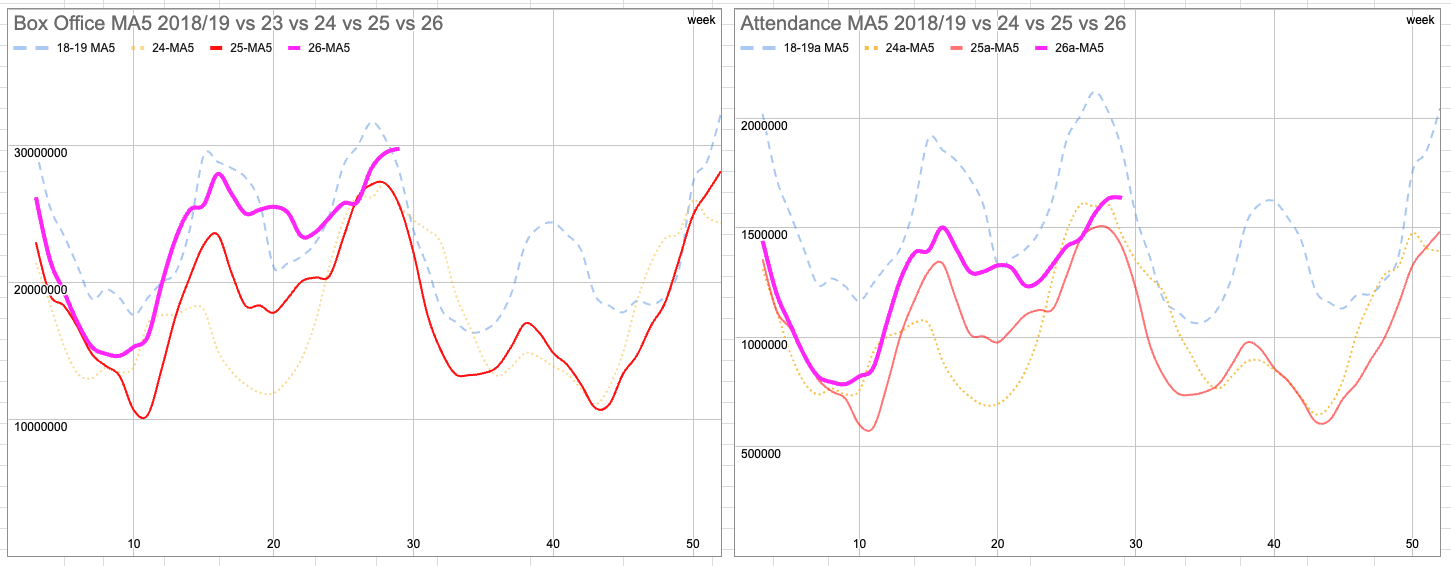
This year has had a better content run than the sector had in 2024 and parts of 2025. The lift through autumn and early winter lines up with a run of broad, recognisable titles and event films. That matters. Cinema remains a product-led business: when the films feel urgent, audiences still respond. The risk is concentration. A stronger year driven by familiar brands, sequels, reboots, remakes and director-led event films can still leave the underlying market exposed. Gower Street's 2026 global forecast describes the calendar as franchise-led, while still forecasting global box office materially below the 2017-2019 average. That is a useful warning: even a good year can sit below the old base. This is not an argument against IP. Sequels and known brands pay bills. They bring people back into the building. The question is what happens in the weeks between them, and whether the industry can keep building broad-market new stories alongside the proven franchises.The Rest Of The Year
The head start is real. It should not be budgeted as though it will keep compounding. A sensible operating assumption is that the year may hold much of the current advantage over 2025, but further expansion depends on whether the back half of the release calendar produces genuine local urgency.- Do not treat +12.38% attendance as a new baseline until several quieter weeks have tested it.
- Protect cash from the strong weeks; the business still needs to absorb thinner weeks and cost shocks.
- Use the event-film lift to rebuild habits: memberships, local school links, seniors, families, fundraisers, filmmaker events and community preview nights.
- Watch the attendance line more closely than the box office line. Revenue can look healthier than the actual audience base.
Are Cinemas Actually Closing?
This is where the story gets more complicated. There is a very real feeling in the industry that cinemas are closing. In some cases, they are. But the more useful question is: are cinema locations disappearing from communities, or are operating businesses changing hands because the economics no longer work for the previous operator? SCO analysis looked at this another way, by comparing the average number of locations playing the top five films across comparable early-year weeks. On that proxy, 2026 is operating at 97.96% of the 2019 active release footprint, or just over 2% down. This is not a perfect census of cinema sites, but it is a useful indicator of how many locations are still active enough to be part of the mainstream release market. Independent Cinemas Australia's June 2026 In Focus paper also makes a useful distinction. It notes that some cinemas permanently exited the market after 2020, while others reopened, were restored, or continued under new ownership. I am not trying to make this an ICA newsletter, but that data supports what many operators are seeing on the ground: the site may survive, while the original operator does not. That matters. For the public, the cinema may look like it is still there. For the owner who lost the lease, the business is gone. For distributors and bookers, the screen may still exist, but the decision-maker, programming strategy and local relationships may have changed.The Lease Problem
The lease problem is one of the big structural issues hiding inside the closure debate. A cinema can have a community, customers and a willing operator, and still not be commercially viable if the rent assumes a pre-pandemic attendance base. Landlords have their own pressures: asset values, financing, centre performance and covenant strength. That can make a larger operator more attractive even where a smaller independent might be better connected to the local audience. So the problem is not always demand. Sometimes it is property economics. A site can close under one operator, sit dark for a period, then reopen with whoever can make the lease work or give the landlord comfort. That keeps the location alive, but it can reduce ownership diversity and make the industry less locally responsive.What This Means For Independent Cinemas
The health of the industry is therefore mixed. Audience willingness is improving when the product is strong. The physical cinema footprint appears more resilient than the public narrative suggests. Premium-format investment shows confidence at the top end. But admissions remain below 2019, the release calendar is still uneven, cost pressures are live, and ownership concentration makes it harder for small operators to compete for sites on equal terms. For distributors, studios, producers and filmmakers, this matters too. Independent cinemas are not only small businesses. They are local market makers. They can build word of mouth, support Australian films, keep specialty titles alive longer, and connect films to communities in ways that a purely centralised model may not.- The opportunity: strong films still move audiences, and 2026 proves the cinema habit is not dead.
- The warning: higher ticket values can mask a smaller attendance base, so do not let box office alone define recovery.
- The strategic pressure: lease structures need to reflect current attendance economics, not only historic centre valuations.
- The independent advantage: local trust, curation, filmmaker access and community partnerships become more valuable when the national slate is uneven.
- The competitive risk: more ownership concentration means fewer independent decision-makers controlling screen access and local cinema identity.
Fuel And Household Pressure
Fuel shock can help and hurt cinemas at the same time. If households travel less and holiday closer to home, local entertainment can benefit. Cinema is still one of the more affordable out-of-home experiences compared with major travel, live events or a full family restaurant night. But if fuel and energy prices keep rising, the same shock can turn from a stay-local tailwind into a household-budget squeeze. The ACCC is publishing weekly fuel-price monitoring during the Middle East conflict, and external energy analysis points to Australia's exposure through imported fuel and diesel-market tightness. For operators, the watch point is not only whether people drive less. It is whether discretionary spend gets pinched. Again, every cinema is different. A regional cinema in a drive-heavy catchment will read this differently from an inner-suburban cinema near public transport. That is the point of doing the analysis. The answer is rarely universal, but the better informed you are, the better chance you have of making the right local decision.- Market cinema as local, easy and lower-friction: no long drive, no expensive weekend away.
- Keep family value offers clear without training customers to wait for discounts on every session.
- Watch food and beverage input costs; fuel shocks can show up in freight and supplier pricing before customers mention petrol.
- Build offers around occasions: wet-weather afternoons, school holidays, local clubs, seniors, mums and bubs, and community nights.
The Real Story Of 2026
The real story of 2026 is not that everything is fixed. It is that the industry has been given a better trading environment and now has to use it intelligently. Attendance is rising. Box office is stronger. The audience will come when the films feel worthwhile. Streaming has become more disciplined. Theatrical is being re-recognised as a valuable release pathway. These are all positive signs. But the reset is still with us. The audience base remains smaller than 2019. The release slate is still heavily dependent on familiar IP. Cost-of-living pressure has not disappeared. Fuel and freight risks are live. Lease economics remain one of the biggest threats to smaller operators. So my view is this: use 2026 as breathing room, not proof that the hard years are over. Bank the gains where you can. Rebuild local habits. Know your numbers. Talk to your landlord from a position of evidence. Watch admissions, not just gross. And remember that an informed decision is a good decision.Decision Watch List
| Issue | What to watch | Suggested response |
|---|---|---|
| Attendance gap | Admissions remain materially below 2019 even as revenue improves. | Track admissions by segment and session, not only weekly gross. |
| Slate concentration | Strong run of recognisable IP may not repeat every quarter. | Use tentpoles to build local habits that carry into quieter weeks. |
| Lease economics | Landlord rent expectations may not match new attendance reality. | Prepare evidence-based lease discussions using admissions, session mix and local data. |
| Fuel shock | Stay-local behaviour may help, but household budgets may tighten. | Position cinema as local value while protecting margin. |
| Industry concentration | Sites may remain open while independent ownership falls. | Collaborate on advocacy, data and programming opportunities. |
Sources And Notes
| Source | Location | Use in newsletter |
|---|---|---|
| SCO analysis | Internal SCO analysis, July 2026 | Weekly box office, attendance, same-week comparisons and active-release-footprint proxy. |
| Independent Cinemas Australia | ICA In Focus: Are Cinemas Closing?, June 2026 | Selected closure, reopening and ownership-transition data. |
| Screen Australia | https://www.screenaustralia.gov.au/insights-and-trends/cinema-industry-trends/box-office/ | Long-run Australian box office and admissions reference. |
| Gower Street forecast | https://gower.st/articles/gower-street-revises-2026-global-box-office-estimate-ahead-cinemacon/ | 2026 global box-office projection and comparison with pre-pandemic averages. |
| Gower Street release-calendar note | https://gower.st/articles/forecast-2026-gower-street-announces-35-billion-early-global-box-office-estimate/ | Franchise-led 2026 calendar context. |
| ACCC fuel monitoring | https://www.accc.gov.au/consumers/petrol-and-fuel/fuel-price-monitoring-during-the-current-middle-eastern-conflict | Weekly fuel-price monitoring during the Middle East conflict. |
| IEEFA fuel analysis | https://ieefa.org/resources/australians-brace-higher-fuel-prices-us-iran-conflict-resumes-again | Australia exposure to imported fuels and diesel-market risk. |
| Quartz franchise context | https://qz.com/1671763/box-office-revenue-from-franchises-is-at-an-all-time-high | Longer-run context on franchise, sequel, reboot and remake box-office share. |
| SCO newsletter archive | https://www.smallcinemaowners.com.au/category/newsletter/ | Tone and format reference for prior SCO newsletters. |
Before I go, I would also like to remind smaller cinemas of a few special offers SCO currently has available. We have a limited number of refurbished Dolby/Doremi DCP2000 and GDC SX-2001A digital cinema player servers available in as-new condition for FREE, plus shipping. We are also offering free CRU enclosures for cinemas needing replacements for failed or damaged units. These must be installed into a server. If interested, please contact me and I will have units prepared for dispatch. You simply need to arrange courier collection. James Gardiner Principal, Small Cinema Owners
