
TL;DR (Read this first)
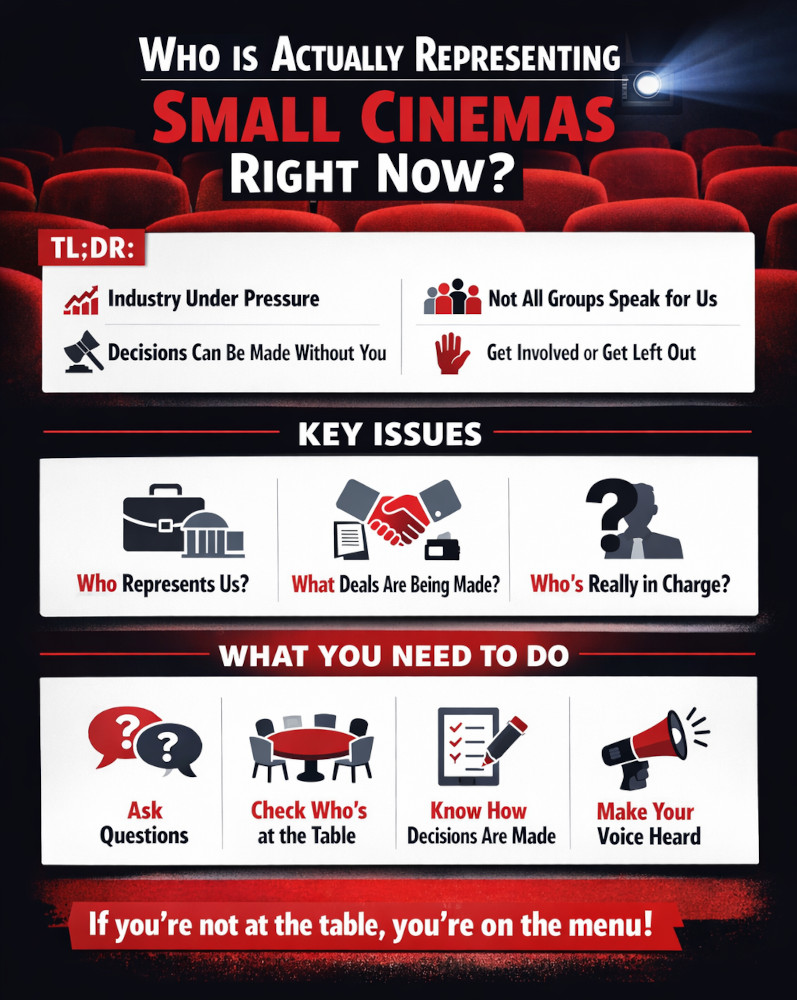
- The industry is under real pressure, attendance is unstable, costs are rising
- Who represents cinemas now matters more than ever
- Not all industry bodies represent all cinemas equally
- If you’re not paying attention, decisions can be made without you
- Engagement in industry governance is no longer optional
The Short Version (2–3 minute read)
Most small cinemas right now aren’t thinking about governance.
They’re thinking about survival.
But in this environment, who represents you matters more than ever.
Costs are rising, attendance is inconsistent, and the traditional business model is under pressure from streaming and changing audience habits.
In times like this, something becomes very important very quickly:
Who is actually representing your interests?
Industry bodies and associations speak to government, influence policy, and often shape how the industry responds to major challenges. But not all organisations represent the full breadth of the sector equally, particularly when independent and regional cinemas are involved.
This isn’t a new issue.
In the late 1990s, the ACCC reviewed the cinema industry after complaints from independent operators about access to films and distributor terms. The findings highlighted how concentrated the market already was, and the structural challenges smaller operators faced.
During the digital rollout, the Virtual Print Fee era created another major shift. Independent cinemas carried significant risk, and disputes during that period raised serious questions about how well smaller operators were represented during negotiations.
Today, we are in another transition.
Different cause, same underlying issue:
Who is making decisions, and who are they making them for?
Some associations operate with selective membership structures or limited transparency around decision-making. That may be allowed under their rules, but it raises a fair question:
Do they represent the whole industry, or just part of it?
For small cinemas, this matters.
Decisions made at an industry level can affect:
- Access to content
- Commercial terms
- Industry initiatives
- The overall direction of the sector
If you’re not engaged, those decisions can happen without your input.
What this means for you
- Pay attention to who represents you
- Ask how decisions are made
- Don’t assume your interests are being covered
- Get involved where possible
Because in a shrinking industry:
If you’re not at the table, you’re on the menu.
Full Article (Deeper Dive)

Institutional Credibility in a Shrinking Cinema Industry
The cinema industry is navigating one of the most significant structural transitions in its history. While exhibition has adapted to technological change many times before, the current wave of disruption, driven by streaming platforms and changing audience behaviour, presents a different kind of challenge.
Attendance patterns are shifting, operating costs are rising, and many cinemas, particularly smaller and regional venues, are under increasing financial pressure.
In periods of stability, industry institutions often operate in the background. Operators focus on programming, operations, and serving their communities, and governance structures receive little attention.
But when the industry comes under pressure, the credibility of those institutions becomes far more important.
Industry bodies represent cinemas in discussions with government, coordinate initiatives, and shape how the sector is presented publicly. Their effectiveness depends not just on formal authority, but on whether the industry trusts them to act in its interests.
At its core, this comes down to a simple question:
Can operators trust the organisations speaking on their behalf?
Lessons from the Past
The Australian cinema industry has faced similar structural tensions before.
In the late 1990s, the Australian Competition and Consumer Commission conducted a detailed review of the sector following complaints from independent exhibitors. The report highlighted a highly concentrated market and ongoing challenges for smaller operators in negotiating with distributors.
ACCC report:
https://www.accc.gov.au/system/files/The%20Cinema%20Industry.pdf
More than a decade later, the transition to digital projection created another period of disruption. The Virtual Print Fee model, used to finance digital rollout, placed significant financial pressure on independent cinemas.
The disputes that followed, including the well known conflict involving Digital Cinema Network and Omnilab Media, highlighted how critical industry representation was during major transitions.
Commentary from that period: ScreenHub article
"DCN vs Omnilab: destroying ICAA`s credibility" - https://www.smallcinemaowners.com.au/wp-content/uploads/2020/10/06-DCN-vs-Omnilab_-destroying-ICAAs-credibility-_-Screen-Hub.pdf
These events raised broader questions about whether independent exhibitors were adequately represented during key negotiations.
The Same Question Today
The current disruption, driven by streaming, release window changes, and evolving audience habits, may be different in cause, but the underlying governance question remains the same:
Who is representing the industry, and how inclusive is that representation?
Membership structures in some associations allow boards significant discretion over who is admitted. While this may comply with governance rules, it raises practical questions about how representative those organisations are.
In an industry with a relatively small number of operators, and a history of dominance by larger players, inclusivity matters.
Independent cinemas, regional operators, and service providers all form part of the exhibition ecosystem. Their voices contribute to the strength and legitimacy of industry positions.
Transparency and Governance
Another key issue is transparency.
Board deliberations are often confidential, which is standard governance practice. However, member-based organisations also carry an expectation that stakeholders understand how decisions affecting the sector are made.
This balance between confidentiality and transparency becomes particularly important where decisions influence:
- Industry initiatives
- Collective negotiations
- Strategic direction
Recent changes within Independent Cinemas Australia, including the discontinuation of its buying group initiative following a leadership change, illustrate how governance decisions can materially impact the sector, even when the reasoning behind those decisions is not publicly detailed.
The Role of Members
Industry bodies derive their legitimacy from their members.
However, in practice, many associations experience limited engagement from members on governance matters. During periods of stability, this is understandable. Operators focus on running their businesses.
But in the current environment, disengagement carries risk.
When members do not actively participate, review leadership, or question decisions, institutions can drift away from representing the broader industry.
This dynamic is not unique to cinema, but it becomes more significant in smaller, concentrated industries like exhibition.
Why This Matters Now
Cinemas are operating in a period of structural change.
Economic pressure, audience fragmentation, and technological disruption are reshaping the sector. In this environment, the quality and credibility of industry leadership has a direct impact on outcomes for operators.
Strong institutions require:
- Transparency
- Accountability
- Broad representation
But they also require engaged members.
Final Thought
Cinema exhibition has always been resilient. But resilience is not just about technology or programming.
It is also about governance.
In a shrinking industry, credibility becomes a form of capital. The organisations that represent cinema exhibition must maintain that carefully.
And for operators:
Engagement is no longer optional.
Want to be part of the conversation?
SCO exists to represent small cinema operators.
If you have views on this topic or want to get involved, reach out.
James Gardiner
Founder, Small Cinema Owners (SCO)
Supporting Independent Cinemas Across Australia
